
"Rs 95 Billion Lost: How Political Interference Is Bleeding Nepal's Telecom Sector Dry"
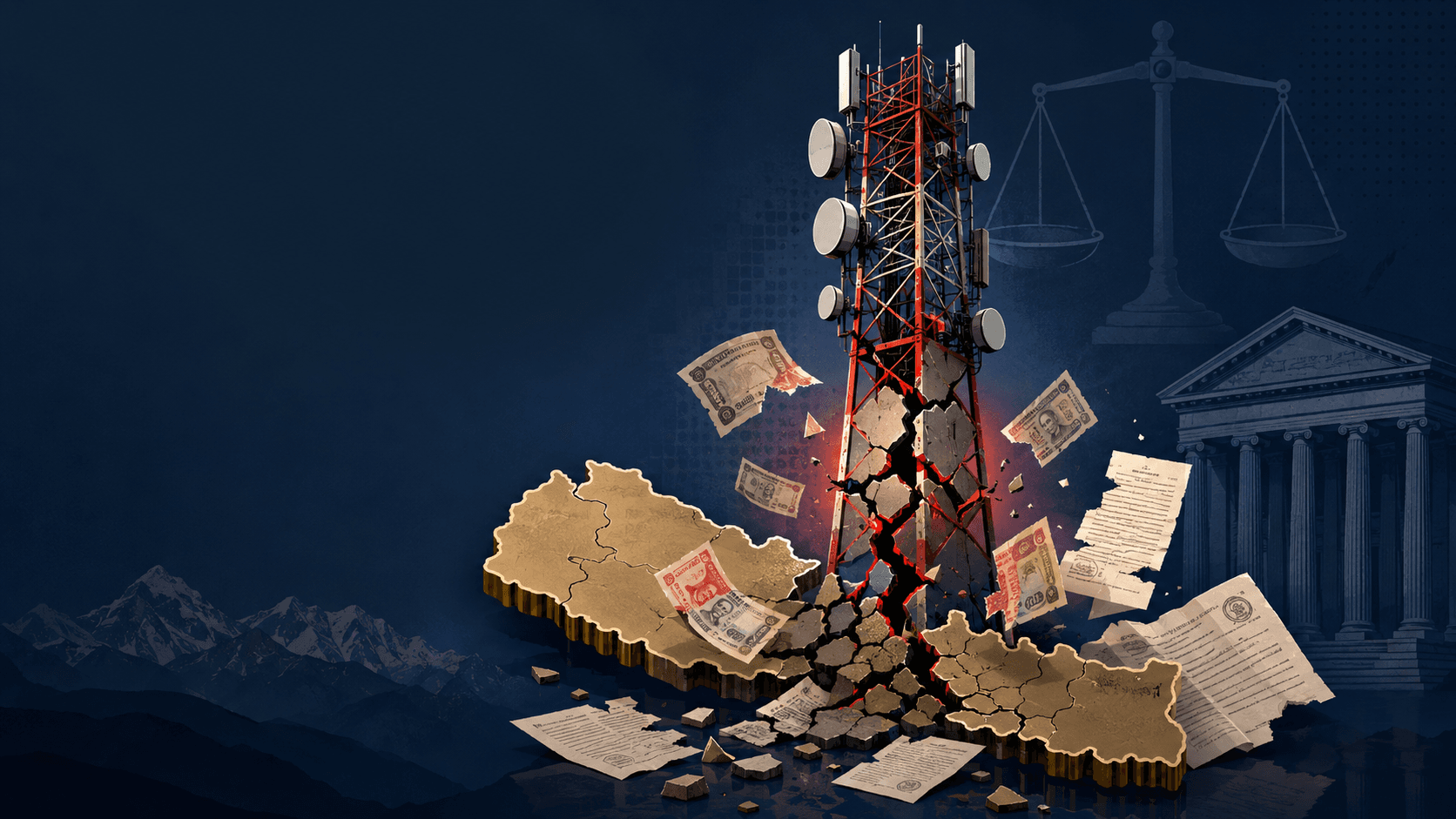
The Anatomy of a Rs 95 Billion Scandal: How Nepal's Telecom Sector Was Systematically Drained
Nepal's telecommunications sector is now at the center of what police investigators are calling one of the largest financial losses to the state in the country's history. What began as the quiet collapse of a struggling mobile operator has unraveled into a case involving Cabinet-level interference, a defunct company's illegally auctioned assets, a formal criminal investigation, and a bill to the state treasury that has now been calculated at Rs 95 billion.
This article traces the full arc of the story — from Smart Telecom's first missed payment in 2019 to the Central Investigation Bureau's (CIB) prosecution recommendation in August 2026 — using investigative reporting from Nepal Lead TV, the Kathmandu Post, and Techpana.
How It Started: A License, a Default, and a Political Rescue
Smart Telecom was once Nepal's third-largest mobile operator. On 28 July 2019, the Nepal Telecommunications Authority (NTA) revoked the company's license after it failed to clear dues that stood at Rs 2.32 billion at the time. Under normal circumstances, that should have ended the matter.
Instead, company representatives appealed directly to the government. Following an appeal from company representatives to the Minister for Communication and Information Technology, Gokul Baskota, the Oli-led government annulled the authority's decision to revoke the license. The Cabinet meeting that reversed the decision was held on 6 January 2020, when it decided to withdraw the letter that had informed Smart Telecom of the license revocation. Two other companies caught in similar situations — Ajeya Raj Sumargi's Nepal Satellite Telecom (Hello Nepal) and the internet service provider Websurfer — had their revoked licenses reinstated in the same move.
As part of the bailout, Smart Telecom was granted a favourable instalment facility to pay its Rs 2.32 billion in dues across five instalments, to be cleared at the end of each fiscal year, with amounts set at Rs 598.8 million, Rs 832.3 million, Rs 774 million, Rs 715.6 million, and Rs 657.2 million respectively. Despite this concession, the company failed to pay even the first instalment for several years.
Four More Lifelines
The pattern didn't stop at one reversal. Over the following two years, the Oli government extended Smart Telecom's payment deadlines on at least four separate occasions:
On 14 September 2020, the deadline for the unpaid first instalment was extended by six months — by which point Communications Minister Gokul Baskota had already resigned over an unrelated audio-leak scandal, and the ministry had passed to Finance Minister Yubaraj Khatiwada before ultimately landing with the Prime Minister himself.
The deadline was extended again until 2022 on 14 March 2021, under Communications Minister Parbat Gurung.
On 12 July 2021, a Cabinet meeting extended the repayment deadline for arrears a fourth time, until mid-January.
Throughout these extensions, the company kept falling further behind. By the time of the fourth extension, Smart Telecom's total dues to the state — beyond license fees — had exceeded Rs 5.5 billion. A subsequent NTA analysis found the company was effectively bankrupt: its total assets stood at Rs 5.277 billion, while its dues had reached Rs 13.6959 billion. By 2026, the state's total loss from Smart Telecom, including license fees, had exceeded Rs 30 billion, with dues for royalty, RTDF, and frequency charges alone surpassing Rs 7 billion.
A Final Legal Gambit — and Automatic Revocation
As Smart Telecom's original 10-year license neared its natural expiry on 15 April 2023, the company made one last attempt to hold on. Unable to pay a renewal fee of Rs 23 billion plus nearly Rs 7 billion in outstanding dues, the company lobbied for a reduced renewal fee of just Rs 1 billion — a proposal raised as a concern in Parliament by MP Padam Giri.
It didn't work. The license automatically expired on 15 April 2023, and on 17 April the NTA moved to take control of the company's assets and begin the infrastructure transfer process. Smart Telecom then tried the courts, securing a temporary interim order from the Patan High Court — but a joint bench ultimately found no basis for the interim order, ending the company's final attempt to retain its license. By law, this meant Smart Telecom's towers, spectrum, and equipment now belonged to the state.
The Illegal Auction
This is where the story takes its most damaging turn. On 22 May 2023, the NTA announced it had taken control of all of Smart Telecom's assets, infrastructure, networks, and equipment. Under the Telecommunications Service Provider Asset Management Regulations of 2079, the authority was empowered to seize and auction these assets to recover government dues — but the required management and pricing committees were never formed, raising suspicion of collusion within the NTA's own leadership.
Into that vacuum stepped Nepal Investment Mega Bank (NIMB), which proceeded to auction the company's assets, infrastructure, and network without legal coordination — leaving the government with no recovery from Smart Telecom at all. The result: despite the infrastructure already being under regulatory control, the bank's unilateral action left the state with losses exceeding Rs 30 billion and "zero in hand."
Notably, an earlier and different resolution had also been on the table. During Sher Bahadur Deuba's government, a scheme considered merging Smart Telecom's cancelled license into Ncell, transferring its liabilities so Ncell could operate the remaining 15 years of the license — a plan the NTA later moved to correct, calling it a deliberate policy error.
Ncell ultimately won the bank's auction with a bid of Rs 4.6 billion. But because the assets were never legally NIMB's to sell, the NTA refused to register the transfer — leaving Ncell to demand either legal registration or a full refund of what it had already paid.
The Criminal Investigation: Rs 95 Billion and 22 Names
The fallout escalated sharply in mid-2026. On 30 July, the CIB arrested Bhupendra Bhandari, the former NTA chairman, in connection with the case. Then, on 7 August, the CIB submitted its investigation report to the Kathmandu District Government Attorney Office. According to the Kathmandu Post's reporting, the CIB has recommended prosecuting 22 people, including nine Ncell officials and two Nepal Investment Mega Bank officials, over the alleged illegal auction kathmandupost.
The scale of the recommended recovery is striking: police have recommended seeking a recovery of Rs 95 billion in damages and prosecuting 22 people as defendants. Investigators concluded that the assets were illegally auctioned through collusion between Nepal Investment Mega Bank and Ncell Axiata Limited, with the case alleged to involve fraud, criminal breach of trust, and organised crime. As of publication, nine of the 22 recommended defendants are Ncell officials, while two are officials of Nepal Investment Mega Bank, and the government attorney's office is now reviewing the report to decide whether to formally file charges in court.
Reading the Two Numbers: Rs 30 Billion vs. Rs 95 Billion
It's worth pausing on why two different loss figures — Rs 30 billion and Rs 95 billion — appear across this story. The Rs 30 billion figure, reported by Techpana, reflects the cumulative losses from unpaid license fees, royalties, frequency charges, and RTDF dues accumulated from Smart Telecom's original 2019 default through 2026. The Rs 95 billion figure is the CIB's damages recommendation tied specifically to the illegal asset auction case — a separate, and larger, claim covering the value of assets and losses linked to the NIMB-Ncell transaction itself. Together, they represent two different (but connected) layers of the same underlying failure.
Why This Is Bigger Than One Company
It would be easy to read this as a story about one failed telecom operator. It isn't. The Smart Telecom case follows a template that shows up repeatedly in Nepal's governance failures:
A regulator makes a lawful call — the NTA correctly revokes a license over unpaid dues.
Political actors intervene — Cabinet decisions repeatedly override the regulator under pressure from "power centres" and intermediaries, as Techpana's reporting puts it.
The company still fails — years of protection buy time but don't fix the underlying insolvency.
A new set of actors exploits the resulting legal vacuum — in this case, a commercial bank auctioning assets it had no right to sell.
Enforcement arrives only after the damage is done — a criminal investigation years later, recovering (at best) a fraction of what was lost.
For a country trying to build investor confidence and strengthen its regulatory institutions, this case cuts two ways. It shows that Nepal's investigative bodies are capable of pursuing politically sensitive cases all the way to arrests and prosecution recommendations — including a former NTA chairman. But it also puts a precise number on the cost of letting political protection override regulatory independence for years at a stretch.
What Happens Next
The case now sits with the Kathmandu District Government Attorney Office, which will decide whether to formally prosecute the 22 recommended defendants and pursue the Rs 95 billion recovery claim. Given the profile of those implicated — sitting and former telecom officials, bank leadership, and regulatory heads — how this case is handled in court may become a broader test of whether Nepal's institutions can hold politically connected actors accountable, or whether this becomes one more entry in a long list of scandals that generate headlines but little actual recovery.
Sources: Nepal Lead TV investigative documentary; Kathmandu Post, "Police recommend recovering Rs95 billion in Smart Telecom asset auction case," August 11, 2026; Techpana, "Inside Nepal's Biggest Telecom Scandal," 2026.
Join the Discussion
Share your thoughts and engage with our community.
Loading comments...
Log in to join the discussion
Register on the platform, verify your email, then comment on this article.