
How Much Money to Start a Cafe in Nepal? 2026 Cost Guide

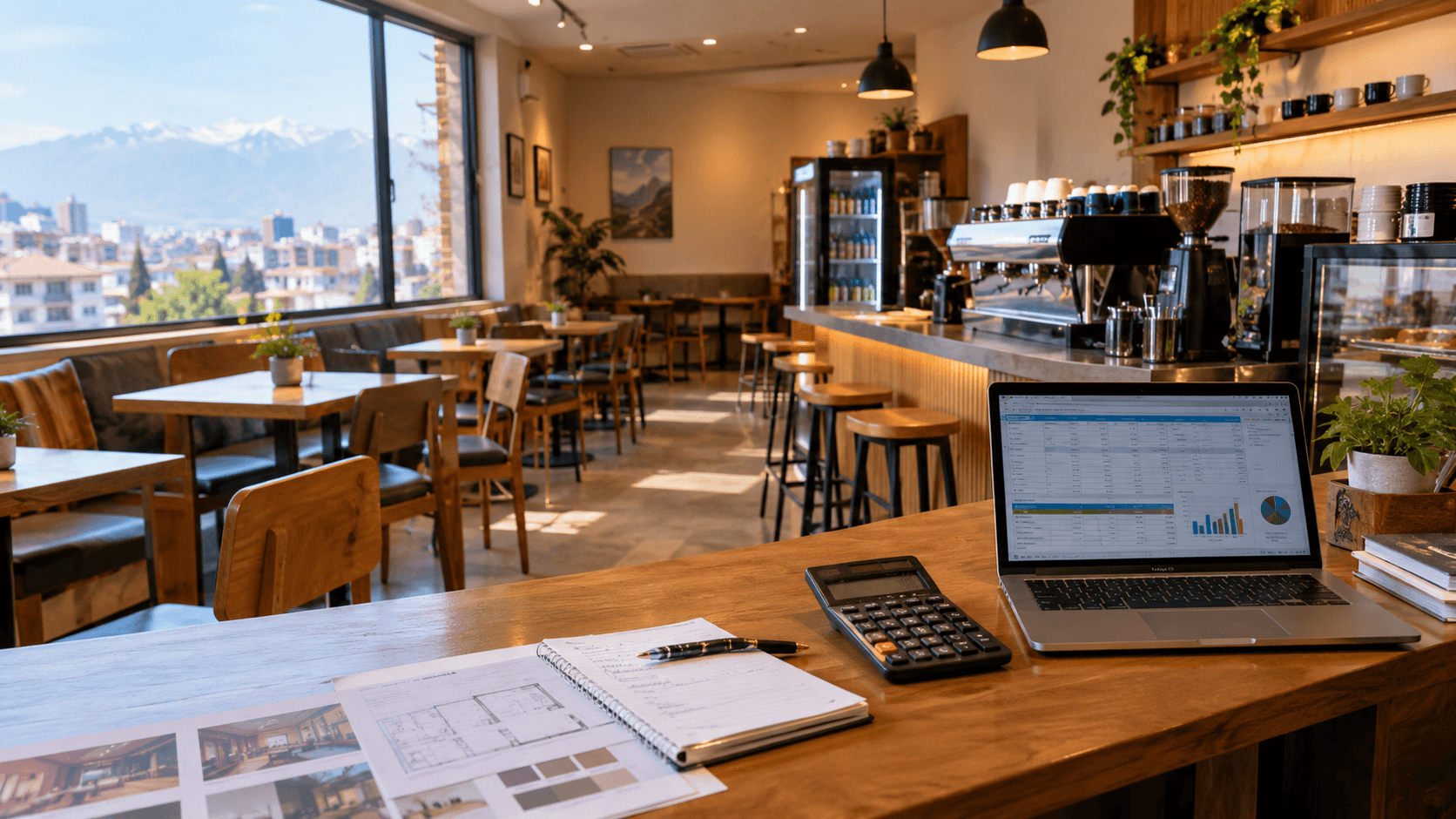
How Much Money Do I Need to Start a Cafe in Nepal? (Complete Cost & Profitability Guide)
Quick Answer
There's no single correct number — but for planning purposes, most conventional small cafes in Nepal fall into one of three tiers:
Cafe model | Starting budget | What you get |
|---|---|---|
Takeaway / small kiosk | NPR 5–10 lakh | Limited menu, minimal seating, low renovation |
Small sit-down cafe | NPR 10–25 lakh | 15–30 seats, standard equipment and interior |
Larger / premium cafe | NPR 25 lakh+ | Better location, stronger interior, bigger menu |
These are planning ranges, not fixed government figures. Your actual number depends on location, rent, interior ambition, and how much of your budget you protect as working capital rather than spending it all before you open.
The useful question isn't "what does a cafe cost?" — it's "what will my cafe cost to open and survive its first few months?"
What Actually Makes Up Your Startup Budget
Break it into ten pieces:
Rent deposit and advance
Interior and furniture
Coffee and kitchen equipment
Initial inventory
Business registration
PAN/VAT and tax setup
Food safety licensing
POS and billing
Staff and marketing
Working capital reserve — the one beginners consistently underbudget
Let's go through each with real numbers where they exist.
1. Rent and Deposit
Instead of asking about the monthly rent, ask "how much do I need before I can open the door? This typically involves security deposit, Advance rent and rent while renovation is in progress when you are paying but not earning. With the landlord asking for several months in advance, this can cost you a few lakh rupees even before you enter the house.
2. Interior and Furniture
It's in the budget where costs grow the quickest. The simple set up (basic tables, counter, shelving, lighting, outdoor seating) is much less expensive than custom furniture, flooring, AC, and outdoor seating. More important than the number: don't put so many efforts into the decoration that you have no money left for stock, wages and the slow first months.
3. Equipment — Decide the Menu First
You don't buy equipment for your menu, your menu determines your equipment. A tea-and-sandwiches shop does not require as much equipment as a full espresso-and-bakery shop. When choosing equipment, make a list of things you need (espresso machine, grinder, freezer, fridge, oven, etc.) after you have finalized the menu.
4. Initial Inventory
Coffee, milk, syrups, bakery items, packaging, cleaning supplies. Size this against your expected first-month sales rather than bulk-buying "to be safe" — unsold perishable stock is wasted capital.
5. Business Registration — Verified Government Fees
If you register as a private limited company, the Office of the Company Registrar charges a fee based on authorized capital: NPR 1,000 for authorized capital up to NPR 100,000, NPR 4,500 for NPR 100,001 to 500,000, NPR 9,500 for NPR 500,001 to 2,500,000, and NPR 16,000 for NPR 2,500,001 to 10,000,000 — I checked this directly against OCR's own published fee notice, and the tiers match exactly.
Most small cafes, though, start simpler: as a sole proprietorship ("private firm"), registered with far lighter formality and cost than a company. Company registration fees are the smallest line item in most cafe budgets — don't let them anchor your overall estimate.
6. PAN, VAT — and a Detail Most Guides Skip
Every business needs a PAN. VAT is different — it's threshold-based, and this is where the Inland Revenue Department's own rules matter more than any secondhand estimate:
If your annual turnover stays under NPR 30 lakh and you're not VAT-registered, you likely qualify for a simplified flat-rate presumptive tax rather than full bookkeeping — a fixed annual amount of NPR 7,500 for businesses in a metropolitan or sub-metropolitan area, NPR 4,000 in a municipality, and NPR 2,500 elsewhere, according to IRD's own published rules.
Between roughly NPR 30 lakh and 1 crore turnover (still not VAT-registered), a graduated turnover-based tax applies instead, with the rate depending on whether you're classified as a goods business or a service business.
Mandatory VAT registration kicks in once turnover crosses NPR 50 lakh for goods or NPR 30 lakh for services or mixed supplies on a rolling 12-month basis — and separately, certain categories must register for VAT regardless of turnover, including restaurants with a bar. If you plan to serve alcohol, budget for VAT compliance from day one, not after you hit a sales number.
Because a cafe's exact classification (goods vs. service) affects which rate applies, confirm it with IRD or an accountant before finalizing your tax plan — these thresholds are also revised by the annual Finance Act, so double-check the current figures before you register.
7. Food Safety Licensing — Under the Current Law
A cafe is legally a food business operator in Nepal. Two licenses commonly apply: a municipal business licenseconfirming zoning compliance, and a food license from the Department of Food Technology and Quality Control (DFTQC), typically requiring a layout plan, premises photos, and a ward recommendation letter. Operating a food business without a DFTQC license is treated as illegal in Nepal.
The Food Act/ Food Regulation from the 60's and 70's is cited in several older guides (including an earlier draft I gave you) - this is a correction. The old framework has been replaced by Nepal Food Hygiene and Quality Act, 2081 (2024) which replaces the 57-year-old Food Act, 2023 (1967) with a newer licensing and food-safety regime. DFTQC now has an applicable licensing process available in its NeFFILS system. Use the current act to give examples of the old one is not relevant.
8. POS and Billing
A basic tablet/computer + POS software + receipt printer setup is a small line item, but it earns its keep by showing you daily sales, best-sellers, and wastage — data you'll need for step 9 below.
9. Staff, Training, and Marketing
Budget beyond the first month's payroll — you need staff costs covered through the period before the cafe builds a steady customer base. For marketing, local visibility (Google Business Profile, social media, an opening promotion) matters more than paid advertising for a single new location.
10. Working Capital — The Cost Beginners Forget
If you spend your full budget getting the doors open, you have no budget left to actually run the cafe. You still need cash for rent, salaries, ingredients, utilities, and taxes while sales ramp up — and sales are almost always slower than projected in month one. Keep a dedicated reserve; don't treat "setup cost" and "startup capital" as the same number.
Sample NPR 15 Lakh Budget (Planning Example)
For a small 15–25-seat cafe with a moderate interior and basic menu:
Expense | Example Budget |
|---|---|
Rent / deposit / advance | NPR 2,00,000 |
Interior and furniture | NPR 4,00,000 |
Coffee & kitchen equipment | NPR 4,00,000 |
Initial inventory | NPR 1,00,000 |
POS and technology | NPR 50,000 |
Registration / licensing | NPR 50,000 |
Branding & launch marketing | NPR 50,000 |
Working-capital reserve | NPR 2,50,000 |
Contingency | NPR 50,000 |
Total | NPR 15,00,000 |
This is illustrative, not a quote — get real numbers from your own landlord and equipment suppliers before committing.
Real Examples From the Nepal Market
Numbers you can actually check, not vague estimates:
One entrepreneur built a mobile coffee cart in Kathmandu gradually, buying a secondhand van, adding structural fittings, and a double-head coffee machine in stages — investing roughly NPR 1.2 million in total by the time it was operational.
A community cafe in Baneshwor, Kathmandu, running three years with 7 staff, generates about NPR 4.5 lakh in monthly sales at a 20–25% EBITDA margin — a useful real-world margin benchmark for a well-run small cafe.
A separate small Kathmandu cafe with 15 seats and just 2 employees stays profitable on an average of only 30–40 customers a day — proof that a lean staffing model can work at modest volume.
Industry observers note that a cafe's appeal in Nepal is partly that the initial investment is comparatively low and the business is simple enough for one person or a family to run.
What If You Only Have NPR 5 Lakh?
A conventional 20–30-seat cafe is difficult on this budget — deposit, interior, and equipment consume most of it. Better options: a takeaway coffee counter, a small kiosk, or taking over an already-fitted food space to cut renovation costs. The principle: reduce fixed costs, don't just buy cheaper equipment.
What If You Have NPR 10 Lakh?
More flexibility, but the same discipline applies: don't spend 80–90% before opening. A small café, takeaway model, or limited-menu café inside existing commercial space all fit this range.
What If You Have NPR 20–25 Lakh?
Room for a better location, stronger interior, and a bigger working-capital cushion — but more capital doesn't automatically mean profitability. The business still comes down to: customers × average spend × margin, minus rent and staff.
Is It Profitable? Do the Math Before You Sign the Lease
Revenue estimate: customers/day × average bill × operating days.
Example: 60 customers × NPR 300 × 30 days = NPR 540,000/month revenue — not profit. Ingredients, salaries, rent, utilities, tax, and wastage all come out of that.
Break-even formula:
Break-even customers = Monthly fixed costs ÷ (price − variable cost per customer)
Example: fixed costs NPR 180,000/month, average bill NPR 300, variable cost NPR 120 →
Contribution = NPR 180 → Break-even = 180,000 ÷ 180 = 1,000 customers/month, or about 34/day.
Run this with your own numbers before committing to a lease — it's the single most useful calculation in this whole guide.
Where to Open
Check foot traffic, customer type (students/office workers/tourists/residents), existing competition density, whether rent is justified by expected demand, visibility, and delivery-platform potential. A cheap location isn't automatically better, and neither is an expensive one — the question is whether demand covers the occupancy cost.
10 Mistakes to Avoid
Overspending on interior before locking the menu
Choosing a location for cheap rent alone
Buying equipment before finalizing the menu
Spending everything before opening — zero working capital
Assuming high sales from day one
Ignoring food/beverage wastage
Mixing personal and business money
Not tracking daily sales
Copying a competitor's pricing blindly
Skipping the break-even calculation
Startup Checklist
Location: rent · deposit · advance · renovation timeline
Setup: interior · furniture · signage · electrical/plumbing
Equipment: espresso machine · grinder · fridge/freezer · oven · blender
Compliance: business registration · PAN · VAT (if applicable) · DFTQC food license · ward recommendation
Operations: inventory · staffing · POS · marketing · packaging
Safety net: working capital · emergency fund · repair budget
FAQ
How much does a small cafe cost in Nepal?
A practical planning range is NPR 10–25 lakh for a conventional small cafe, with takeaway/kiosk formats possible for less.
Can I start with NPR 5 lakh?
Possible for a very small or takeaway format; difficult for a conventional sit-down cafe once deposit, interior, and equipment are accounted for.
Does a cafe need VAT registration?
Only past the applicable threshold (NPR 30 lakh for services/mixed supply, NPR 50 lakh for goods, on a rolling 12-month basis) — or immediately, regardless of turnover, if you're serving alcohol. Confirm your specific classification with IRD.
Does a cafe need a food license?
Yes — under the current Food Hygiene and Quality Act, 2081, food businesses require licensing through DFTQC's system before operating legally.
How much working capital should I keep?
No fixed government figure — calculate your own expected monthly rent, staff, ingredients, and utilities, then hold that much (commonly 2–3 months' worth) in reserve rather than spending it on setup.
Join the Discussion
Share your thoughts and engage with our community.
Loading comments...
Log in to join the discussion
Register on the platform, verify your email, then comment on this article.