
How Nepal's Taxpayer Incentive Gift Program Works And How to Prepare Your Invoicing Bill Lottery Nepal
A complete guide to Nepal's new bill lottery how the daily and fortnightly draws work, what counts as a valid entry, and what business owners need to fix in their invoicing before the next draw
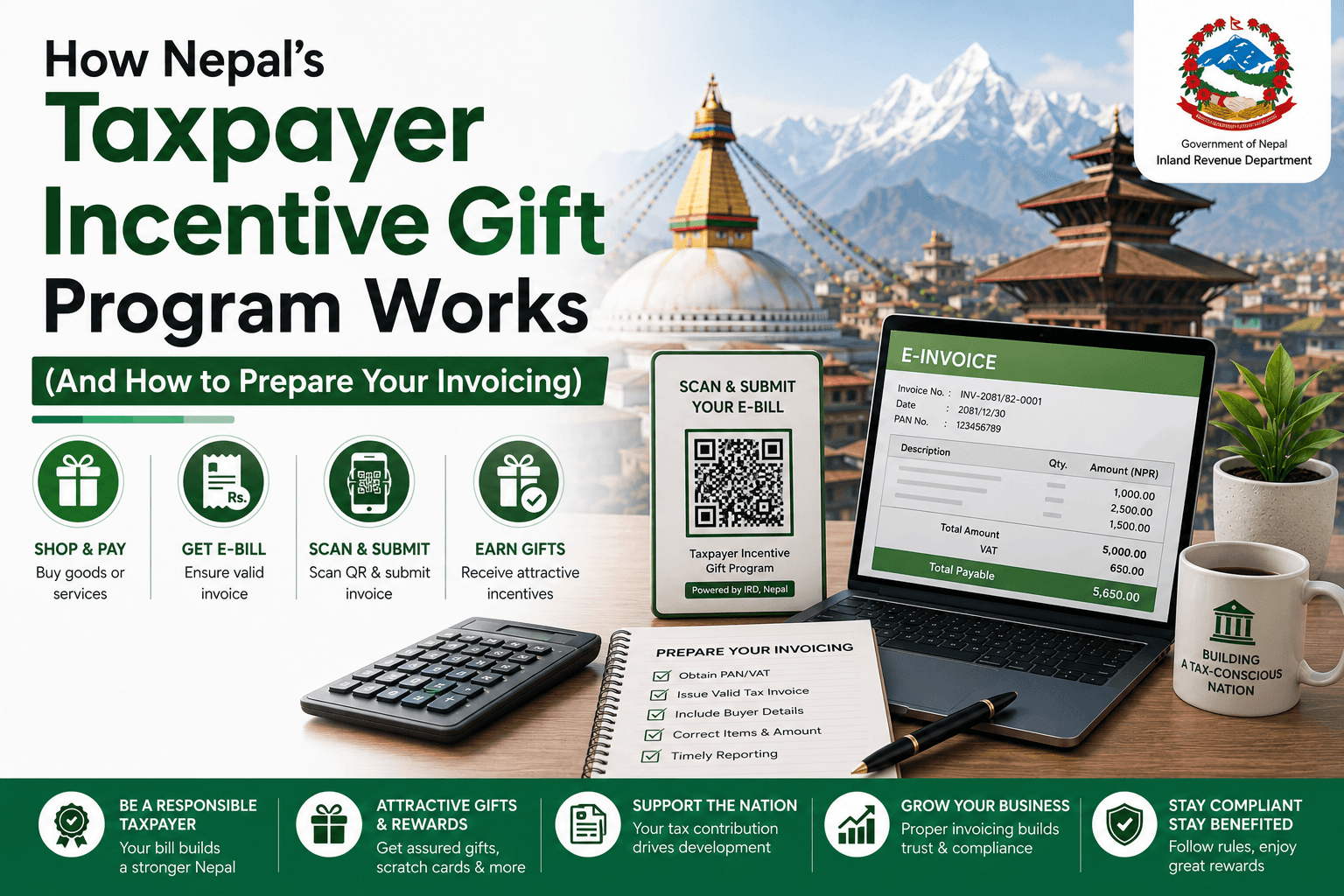
How Nepal's Taxpayer Incentive Gift Program Works (And How to Prepare Your Invoicing)
Category: Digital Payments | Estimated read time: 6 min
Ask for your bill, get entered into a government lottery — that's the simple idea behind Nepal's newest tax policy, and it's already making headlines. A shopper in Kanchanpur turned a Rs 250 grocery bill into a Rs 1 million prize, and stories like this are pushing more consumers — and more businesses — to pay attention to invoicing than ever before.
If you run a business in Nepal, this program isn't just a curiosity. It changes how your customers will behave at checkout, and it raises the stakes for getting your billing and VAT compliance right. Here's what the program actually does, and how to get your invoicing ready.
What Is the Taxpayer Incentive Gift Program?
The Taxpayer Incentive Gift Program, 2083 is a government-run consumer lottery approved by the Ministry of Finance and operated by the Inland Revenue Department (IRD). Its core purpose is to nudge everyday cash transactions into the formal, tax-recorded economy by rewarding customers simply for collecting a valid bill (Kumari Job).
The logic is straightforward: Nepal loses significant VAT revenue when sellers under-report sales or skip billing altogether. Rather than adding new taxes or relying purely on enforcement, the government is now paying consumers to demand invoices — flipping the usual "no bill, cheaper price" negotiation on its head (Kharcha Patra).
The procedure was approved in mid-July 2026, and the Inland Revenue Department opened its official registration portal shortly after, with invoices issued from July 17 onward eligible for entry (Nepal News).
How the Program Works
Who's eligible: Any Nepali citizen with a PAN who spends more than Rs 100 on a single personal purchase, from a VAT/PAN-registered seller, qualifies for one entry. The purchase must be for personal use — not for business — and a personal PAN is required to register or claim a prize (Kumari Job).
Digital vs. cash payments: This is the detail that matters most for your invoicing setup. When a customer pays digitally — through mobile wallets or QR-based payment services — their transaction is automatically reported to the IRD's server and entered into the draw with no extra steps. Digital transaction volume has already surged: more than 2.56 crore transactions were automatically registered through digital channels in just the first fifteen days of the scheme (Ratopati). Cash payments, by contrast, require the customer to manually upload their bill details — including the merchant's PAN, purchase date, and amount — on the IRD's dedicated portal before the draw.
What doesn't count: Utility payments — electricity, water, telephone, internet, and airline tickets — are explicitly excluded from the scheme, even if paid digitally. Only purchases from VAT/PAN-registered commercial sellers qualify.
One bill, one ticket: Each valid invoice generates exactly one entry, so splitting a purchase into multiple small bills won't multiply a customer's odds.
Prize Structure and Draw Schedule
The IRD runs an automated electronic draw twice a month, on the 1st and 16th of the Nepali calendar:
- Daily prize: Rs 1,33,334 (gross), paid out to one winner per day in the draw window
- Fortnightly bumper prize: Rs 10,00,000 (gross), awarded to one additional winner every 15 days
Both prizes are subject to a 25% windfall-gain tax deduction under Section 88A of the Income Tax Act 2058 — which is why the gross daily prize works out to a clean Rs 1,00,000 net, and the bumper prize nets out at Rs 7,50,000 (Kharcha Patra).
What This Means for Your Business
For business owners, this program is a strong signal — not just about tax policy, but about customer behavior:
- Customers will ask for bills more often. The "skip the bill, save the VAT" negotiation that many small shops rely on now has a real cost for the customer — walking away without a bill means walking away from a lottery ticket.
- Digital payment adoption will keep rising. Since digital transactions enter the draw automatically, customers have a built-in incentive to prefer QR and mobile wallet payments over cash, adding to a shift that was already underway across Nepal's digital payments landscape.
- Invoice accuracy will be scrutinized more. With more consumers registering their own bills through the IRD portal, mismatches between what a business reports and what customers submit are more likely to surface.
How to Prepare Your Invoicing
If you run a shop, restaurant, or service business in Nepal, here's how to get ahead of this shift:
- Make sure your PAN/VAT registration is current and correctly printed on every bill. A bill without a valid PAN can't be registered by your customer, which means lost goodwill even if it doesn't affect your own compliance.
- Issue a bill by default, not on request. With customers now motivated to ask, treat every transaction as bill-eligible rather than waiting to be asked.
- Upgrade or double-check your digital payment acceptance. Since digital payments auto-register for the lottery, offering QR and wallet payment options makes the experience smoother for customers and reduces manual paperwork on their end.
- Train staff on the new customer expectation. Front-line staff should understand why customers may now insist on a bill for even small purchases, and be ready to issue one without friction.
- Reconcile your invoicing system regularly. As registered bills from customers increasingly get cross-checked against business-reported sales, keeping your own records accurate and timely reduces the risk of discrepancies during a tax review.
If you haven't reviewed your broader tax obligations recently, it's worth revisiting our guide to Nepal's Tax System Explained (2026) for a full breakdown of income tax, VAT, and corporate tax rules, and our earlier piece on Nepal's New Tax Reforms 2026 for context on the policy direction driving programs like this one. If you're still setting up your business, our step-by-step guide to registering a company in Nepal covers the PAN and VAT registration steps this program depends on.
The Bigger Picture
This program is a low-cost, high-visibility way for the government to formalize more of Nepal's economy without raising taxes — and early numbers suggest it's working, at least in terms of getting people to ask for bills. For businesses, the smartest response isn't to see this as an enforcement threat, but as a nudge toward habits — accurate billing, digital payment readiness, transparent reporting — that support healthier financial planning in the long run. Our guide on financial planning for businesses in Nepal is a good next read if you want to build these habits into a broader financial strategy.
Ready to register your bill or check the winners list? Visit the official IRD Taxpayer Incentive Portal at prize.ird.gov.np to register a cash-purchase invoice or look up the latest daily and fortnightly draw results. For general PAN/VAT services, the main Inland Revenue Department site is at ird.gov.np.
Note: Program details, draw schedules, and portal availability can change. Always confirm the latest rules directly on the official portal before relying on specifics for your business.
Join the Discussion
Share your thoughts and engage with our community.
Loading comments...
Log in to join the discussion
Register on the platform, verify your email, then comment on this article.